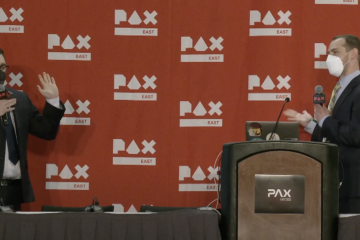
Looking to spend a couple of hours this weekend with passionate gamers diving deep into what makes the storytelling of video games so awesome? With a Terrible Fate is excited to be offering to presentations at a virtual PAX Australia 2021, and we’d love to see you there! Both panels are free and publicly available on PAX’s Twitch streams—and you’ll see the faces and fine work of three WaTF analysts who are presenting at PAX for the very first time, along with some familiar PAX veterans!
Read on to find out what to expect from these panels and where to find them—and we hope to see you on Twitch and in PAX Aus’ Discord this weekend!
Note: Given that this is an Australian convention, please mind time zones when planning to attend the presentations. For convenience, we’ve listed the stream times in AEDT (Australia Eastern), GMT (Greenwich Mean Time), and ET (U.S. Eastern) below.
Beyond Mass Effect: The Power of Ethics in Modern Gaming
Saturday, October 9th, 11:00 a.m. Australian Eastern Daylight Time / Saturday, October 9th, 12:00 a.m. GMT / Friday, October 8th, 8:00 p.m. Eastern Time | Twitch.tv/PAX2

When it comes to literature, the ethical dimension of stories presents some of the richest opportunities for fiction to change your perspective on the world and your place in it—but the notion of “ethics in gaming” has sadly become associated with (1) baseless claims that video games make people violent or (2) relatively superficial “ethical choice systems” in games like Mass Effect. In this panel, we’ll offer gamers tools and opportunities to have better conversations around this topic by exploring and celebrating the real ability of games to represent a moral universe that can improve our real-world decision-making and also convey unique literary value.
I’ll be presenting this panel alongside my great friends and fellow analysts, Richard Nguyen, Caymus Ducharme, and Max Gorynski. Richard will be drawing on his previous study of the moral binary in gaming; Caymus will be presenting something brand-new on The Last of Us Part 2; Max will be putting his work on EarthBound in conversation with This War of Mine; I’ll be extending the views I’ve developed in recent studies of Code Vein and Ni No Kuni to the modern classic, Sekiro: Shadows Die Twice.
The Metagame You’ve Never Heard of: Analyzing Game Stories
Sunday, October 10th, 11:00 a.m. Australian Eastern Daylight Time / Sunday, October 10th, 12:00 a.m. GMT / Saturday, October 9th, 8:00 p.m. Eastern Time | Twitch.tv/PAXAustraliaOfficial

When we’re not busy gaming or analyzing the stories of those games, the analysts of With a Terrible Fate think a lot about what it even means to analyze the story of a video game. The work we publish on With a Terrible Fate is grounded in the text of video games and strives to illuminate them in ways motivated by that text, so it’s not the same as mere “speculation”—but it also goes beyond a mere reconstruction of a game’s plot, aiming to understand the totality of the game’s fiction as a cohesive whole that might not be obvious from the mere sequence of events that transpire within the fiction. It’s not easy to understand what this kind of method actually consists in or what its benefits are, but that’s exactly what we’ll be doing in this panel: outlining a method for “metagaming” the stories of your favorite games, or developing new, principled modes of interpretation and playstyle to gain fresh perspectives on the content and messages of their fictional worlds.
I’ll be presenting this panel in conjunction with two of my other great friends and fellow analysts, Adam Bierstedt and Lauren Spohn. Adam will be using Hollow Knight as a case study for how different approaches to playing a game can lead you to interpret its story in a wide variety of distinct, illuminating, textually motivated ways; I’ll be presenting my theory of the fictional player, which grounds my current approach to video-game analysis, and conducting a case study of Ni No Kuni: Wrath of the White Witch to show how analyzing your involvement in video-game stories in this unintuitive way can unlock a whole new dimension of story in your favorite games; Lauren will be drawing on everything from Hamlet to cosplay to networking to her own work on the music of Zelda to show how the analysis of video-game stories can shape and enrich our real-world lives.
We’re sad to be missing an in-person convention with our Australian friends this year, but we’re absolutely honored and delighted to be part of this historic effort to keep the spirit of PAX Aus alive online. We hope to see you there. And, if you do come, keep the conversation going with us online after the panels on PAX Aus’ Discord server: our favorite part of PAX is the time spent chatting with like-minded gamers long after the panels are over!

0 Comments