To followers of With a Terrible Fate and newcomers alike:

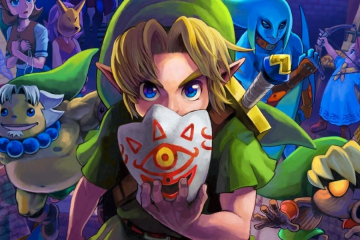
With “Majora’s Mask 3D” finally here, you might be wondering what’s in store for With a Terrible Fate.  As I said yesterday, the remake’s arrival signaled the end of my analysis of the original game.  However, the analytic project of this site is far from over; rather, it’s only now beginning.

In Interludes 1 and 2, I discussed the potential for our understanding of video games and their stories to grow by cultivating robust methods of analysis.  Recall also the following passage from my analysis of the line, “you’ve met with a terrible fate, haven’t you”:

“This is what makes the line, in my mind, so significant:  beyond encapsulating the aesthetic dynamics of “Majora’s Mask,” it can be read as an argument for the nature of video games as a medium.  The player turns on a game and is informed by the game that, in turning it on and engaging it, they have brought a universe to life; yet the persistence of the universe in contingent upon the player’s choice to continue playing the game.  The game establishes a coherent universe, and yet the most basic authority of that universe must be ceded to the player…  This is why I have chosen to make this line the namesake of my work on this blog:  it is the open front door of gaming as a medium, inviting the player to create a work of art by mere virtue of experiencing it.”

This mode of analysis from a perspective of player authority, as inspired by “Majora’s Mask,” is something that I aim to refine and apply to a variety of video games.  I have already begun this project with my recent analysis of the metaphysics in “Xenoblade Chronicles.”  With a Terrible Fate will continue to hone its analytic methodology by attacking the aesthetic puzzles of as many games as possible — and, if you head over to our Facebook page (and like us if you don’t already), you might just get to help decide what game will meet with a terrible fate next.

Majora's Mask New 3DS

Oh, and let’s not forget the promise I made to analyze “Majora’s Mask 3D” with respect to the original version.  You can bet that, after a brief hibernation in which I open a New 3DS and traverse Termina once more, I will make good on that promise as well.


Avatar photo

Aaron Suduiko

Aaron Suduiko is the Founder and Chief Video Game Analyst of With a Terrible Fate. In his capacity as a philosopher of video-game storytelling, he specializes in the relationship between player and avatar, and the myriad ways in which that relationship centrally influences the stories of video games. The heart of Suduiko's philosophy of video-game fiction is his theory of "the fictional player": according to this view, the player's role in a video game is not that of identification with the game's avatar; instead, the player plays a separate, more metaphysically foundational fictional role that makes possible events within a video game's story actual, similar to Leibniz's conception of god. Suduiko's application of this view in his analyses on With a Terrible Fate have led to novel interpretations of games such as Bloodborne, Dark Souls, Dishonored, NieR, Returnal, Xenoblade Chronicles, Bandai Namco's "Tales of" series, BioShock Infinite, Code Vein, Final Fantasy VII Remake, Ni No Kuni, and Silent Hill. The foundations of the fictional player theory may be found in the Journal of the Philosophy of Games: https://journals.uio.no/JPG/article/view/4799/5504 Suduiko graduated Harvard College in 2017 with high honors in his major, philosophy. Part of his degree included three independent studies on the storytelling of video games, advised by philosophy professors. In his senior year, he wrote an honors thesis on the ontology of video games as a storytelling object, earning high honors for the written work and highest honors for his oral defense of it. Suduiko has shared his work on the philosophy of video-game storytelling at a variety of venues, including: Harvard’s philosophy department; PAX West, PAX East, PAX South, and PAX Aus; Harvard’s annual ARTS FIRST festival; the British Society of Aesthetics’ postgraduate conference; and SUNY Oneonta’s undergraduate philosophy conference. An article adapted from a chapter of his thesis on the ontology of video-game storytelling was published in the peer-reviewed Journal of the Philosophy of Games. His work on the aesthetics of quantum mechanics in BioShock Infinite was published in Cornell’s undergraduate philosophy journal, Logos. He’s advised Harvard librarians about the literary value of video games and the need to make them available as library resources. Suduiko started analyzing video games in his senior year of high school, when he compared and contrasted the role-playing dynamics of video games and stage plays. After he started his degree in philosophy in 2014 and heard about the 3D remake of Majora’s Mask, he created With a Terrible Fate as a personal blog analyzing the philosophical and artistic value of Majora’s Mask. Since then, he’s grown With a Terrible Fate into a publication of video game analysts striving to understand the stories of video games in new, rigorous, illuminating ways. Suduiko is currently pursuing a PhD in philosophy at the University of Southern California. Beyond the direct analysis of video-game stories, his main research interests center on how the structure and dynamics of video-game stories can serve as novel models for illuminating real-world issues of practical reasoning, social context, and personal identity.

0 Comments

Leave a Reply

Avatar placeholder

Your email address will not be published. Required fields are marked *