In my long, storied career playing video games, I’ve developed something of a personal lexicon for describing my own experiences. Sometimes, in happy accidents, I find that these terms are relatable to others in a way that might illuminate their own experiences for them and lead to further engagement in meaningful discourse. It’s my selfish hope that the term I will be relating today will open these kinds of doors moving forward.
Ladies and gentlemen, boys and girls, it is with distinct pleasure and no real discernible degree of humility that I present to you, “The Gwyn Moment.”
(Spoilers for Dark Souls, Deathloop, BioShock Infinite, and FInal Fantasy XV are ahead.)
I first played Dark Souls in 2013 in the relative comfort of my Cornell University dorm room. Late to the party, I know, but this was during a lengthy phase of my young adulthood when I would steer clear of anything that was recommended to me. I had a five-part process, you understand, that would delay my enjoyment of any good media that came across my desk:
- A close personal friend would recommend something to me.
- My dander would go up and I would think, “How dare this person, for whom I have great affection, presume to have any idea what I would like?”
- Make fun of this treasured person in my life about this thing they enjoy for months while staying far away from this thing.
- Finally pick up this thing months, if not years, after its initial popularity and become obsessed with it.
- Tell that same friend who recommended it to me in the first place that it’s genius and I loved it.
It was a foolproof system that never failed me. Well, I say it never failed me, but I suppose that’s a matter of opinion. I didn’t watch Breaking Bad until 2014.
I had made it to Step Four with Dark Souls, and while I was certainly obsessed with it, I’d be lying if I told you I was enjoying it. It was everything that my friends had told me it was: obtuse and esoteric, difficult and frustrating, but ultimately strangely addicting. In retrospect, I had no real idea how to play the game, and I was falling into the trap of spreading my stats out to the point where no one weapon really did any damage, I died in just a few hits, and I had no concept of how the armor and maneuverability systems worked. I had not yet, to borrow some insufferable parlance, “Gotten Gud.” I wasn’t having fun and at times would get so angry with the game that I would turn off my PS3 in a rage and do something heinous like study for an econ exam.
But I kept at it. I’m not sure if it was the fire in my belly stoked by the prospect of telling my friends they were wrong—that this was, in fact, a bad game—or if it was just because this was one of the only games I had available to me in my little dorm room away from my home library. Regardless of the reason, I stuck with my terrible dexterity build and eventually made my way to the final boss. It was this moment that completely turned everything around for me and made Dark Souls one of my favorite games of all time.
I was getting to the point with the game that I was eagerly awaiting its end so I could stop playing it and never return to it. I was minutes away from texting my friend over at Ithaca College to let him know how wrong he was, and how Dark Souls was nothing but an overblown frustration machine loved only by weirdo masochists, when I walked through that final fog wall, entered Gwyn, Lord of Cinder’s drab and depressing hovel, and heard those three infamous notes…
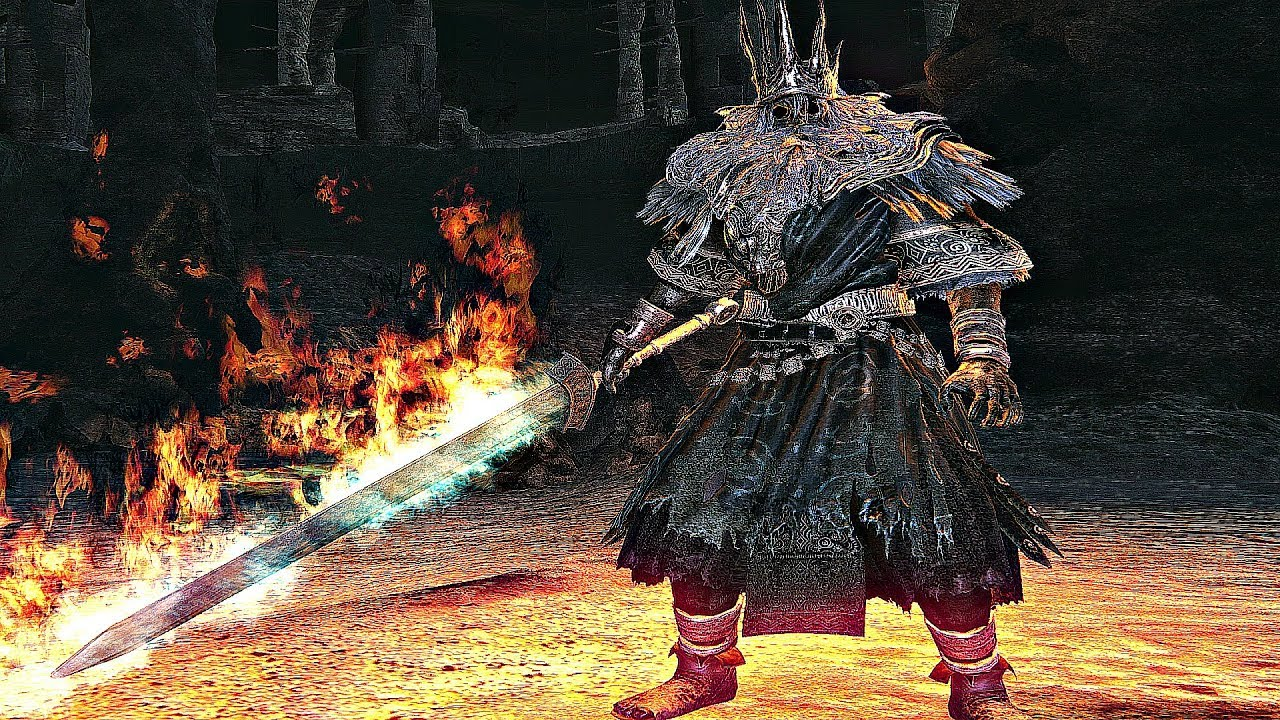
“Plin, plin, plon…”
I had just gone through an entire game where each and every boss encounter was this gigantic, eldritch-bordering monster forgotten by time and exerting their intense power over their little patch of Lordran. All of them had these over-the-top orchestral tracks that indicated, “These are forces to be reckoned with, can’t you hear all the Latin for God’s sake?!”, and each of them left me feeling dejected and unimpressed. Yet here, at the final moment of the game, after all that bombast, here was this supposed deity turned sad old man accompanied by one of the most haunting, somber piano tracks I had ever heard in my life.
At this moment, the entire game came into focus for me. Suddenly, I realized: this is Gwyn, Lord of Cinder, the god of this mythos who shaped the world to his liking, and he is nothing more than a withered husk. He had lost his purpose, and this was less of a final confrontation and more of a funeral putting this worldview to rest. I realized I had never asked who this person was, nor what it was exactly that I was doing in this game.
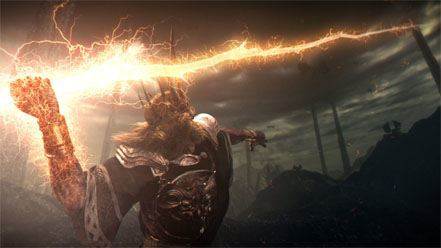
Pictured: Gwyn Absolutely Loving Life
The opening cinematic is famously one of the only pieces of concrete lore that is given to you in Dark Souls, and up to this point, it had seemed as convoluted to me as the rest of the game. Gwyn and his buddies, the Lords, were living in a world dominated by deathless dragons. Gwyn harnessed the power of fire, laid low these dragons with the other Lords, and brought about the Age of Fire in which they supplanted the dragons as the hegemonic force in the world. Standard mythopoeia, I suppose, but nothing that tied me to the world or my place within it, so I largely forgot about it until I started fighting Gwyn at the end of the game. I started to ask myself, “Who is this person?” The answer still chills me when I think about it.
Gwyn was a man with all the power and influence in the world; he liberated existence from the tyranny of the dragons and cemented himself as the de facto king of Lordran. Nothing was beyond his grasp, and everything he did was in service of continuing the Age of Fire and perpetuating his power and control over the world. This, naturally, led to corruption in more ways than one, and he found that the world was soon passing him by. Other forces crept in, decay and the curse of undeath took hold of the world’s citizens, and this once-powerful man turned into a sad, empty husk desperately holding onto the purpose that once drove him. “Don’t you dare go Hollow,” they had said…
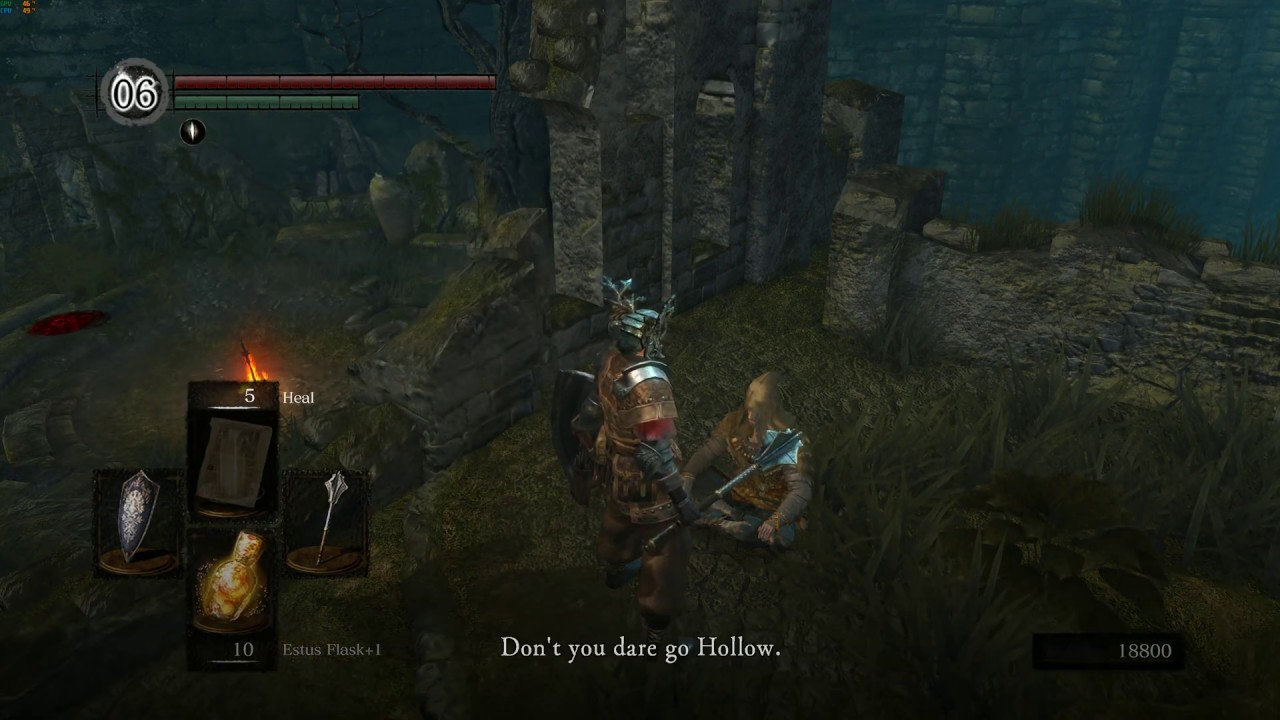
Suddenly it clicked. Lordran, the world of Dark Souls, was dead. All the frustration I had felt traversing the world must be what Gwyn felt in his fruitless attempts to keep the status quo going, only to lose the initial purpose that drove him in the first place. This towering figure of a deity had gone hollow, and who’s to say I wouldn’t go the same way eventually?
In a beautiful way, this realization gave me renewed purpose: to experience the game again and again through this lens I had cultivated in this one exquisite moment. What if I play through with this idea? What could I find out about the game—and, more importantly, about myself—if I continue down this path seeking to avoid Gwyn’s ultimate fate? Well, I can tell you, the answer to those what-ifs was a deep appreciation for the storytelling and world of Dark Souls, and a lifelong appreciation for the work of Hidetaka Miyazaki and FromSoftware. The Gwyn Moment, then, is what I refer to as those perfect, crystallizing moments in games where I begin to see through the matrix and develop a deep, meaningful connection with the narrative.
I’ve had many of these moments since that 2013 playthrough in my tiny dorm room: understanding the father-daughter relationship at the end of Deathloop, piecing the threads together at the end of Bioshock Infinite, or the final moment in Final Fantasy XV when Noctis finally emotes to his friends after going through a hellish experience, but I’ll always consider these “Gwyn Moments” for that palpable sense of reversal I had in understanding the entire point of Dark Souls.
It’s rare nowadays for games to have this kind of effect on me, but I always cherish it when it happens. There’s a certain cynicism that comes with game analysis that I try very hard to stay away from as I get older and have more and better experiences with video games, because if I kept that same five-step system I had in my early twenties, I’d close myself off to all these great moments where my understanding of something is challenged, reversed, and deepened all in one beautiful moment in time.
And who knows? Perhaps the next one is [HYPERLINK BLOCKED]
Continue Reading
- Listen to the Director’s Commentary for this article

1 Comment
EatTheLoad · April 14, 2022 at 2:36 pm
Small note the to the author:
Gwyn is not hollow. He isn’t a human and only humans go hollow.
He looks like that because he burnt himself up real good by linking the fire. Outside of lore, he looks that way as a thematic mirror of the player.
He either can’t talk anymore or has zero interest in doing so. He is 100% not hollow.