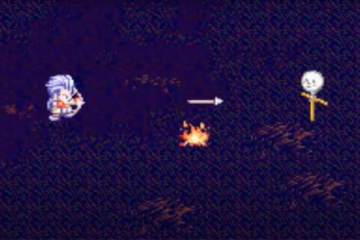
The Tales that stay with us are the Tales that call us to action.

19 years ago, I walked into a Blockbuster and discovered Tales of Symphonia, a game which I carry with me to this day. It was the first JRPG I ever played, and it was the first game that forced me to treat video games as a form of storytelling before all other functions. I played it more times than I can count or remember on my Nintendo GameCube, so much so that the story wove itself into my DNA, driving my subsequent taste in games in ways I recognize without completely understanding. It left me with a love not only for video-game stories, but also for Namco Tales Studio, the powerhouse behind a pantheon of thoughtful, passionate, unapologetically intricate JRPGs for almost 30 years.

Over the years as I’ve studied and published on the storytelling of video games, I’ve kept the Tales games away from With a Terrible Fate because the games felt too close to my source code as a gamer to analyze or share with others. But last month, after 19 years, Bandai Namco released a remastered edition of Tales of Symphonia—calling old and new generations of gamers to save Sylvarant, and calling me to revisit a series at the heart of how I think about gaming, literature, and the world. By way of answering that call, I offer “Tales of Praxis”: a series of weekly reflections on the Tales series as landmark works of interactive storytelling, in the spirit of With a Terrible Fate’s series like “The Legacy of Final Fantasy VII Remake,” “A Comprehensive Theory of Majora’s Mask,” and “Now Loading the Video Game Canon.”

The series is as much a personal reflection as anything. It doesn’t promise to be a complete retrospective, touching on every Tales game in chronological order. I’m replaying those Tales games that impacted me as a gamer and a philosopher of video-game stories, and I’m offering thoughts about that impact—sometimes small thoughts on moments in Tales of the Abyss, sometimes large thoughts on the trajectory of plotlines in Tales of Arise. There’s no unifying thesis tying these studies together, except for the feeling that these stories have a special way of involving the player, calling the player to action, despite being the sort of video game that superficially focuses more on complex character motivations and relationships than on player actions. In that same spirit of action, as I replay Tales of Symphonia for the first time in at least a decade, I invite those who are interested in studying the series to follow that activity on With a Terrible Fate’s Twitch channel, M/W/F 7pm-10pm ET, starting Monday, March 6th. While we’re starting with Tales of Symphonia, I hope that we might adventure through a wide range of the Tales games together to better understand and appreciate the nuances uniting them and distinguishing them from each other.

If you’re lucky enough as a child to find a story that connects you to the personal world of its characters, and then connects that personal world to the cosmic concerns of living, you will seek out that connectivity in everything you do from then on. Join me on a journey through my library of those stories.


Aaron Suduiko

Aaron Suduiko is the Founder and Chief Video Game Analyst of With a Terrible Fate. In his capacity as a philosopher of video-game storytelling, he specializes in the relationship between player and avatar, and the myriad ways in which that relationship centrally influences the stories of video games. The heart of Suduiko's philosophy of video-game fiction is his theory of "the fictional player": according to this view, the player's role in a video game is not that of identification with the game's avatar; instead, the player plays a separate, more metaphysically foundational fictional role that makes possible events within a video game's story actual, similar to Leibniz's conception of god. Suduiko's application of this view in his analyses on With a Terrible Fate have led to novel interpretations of games such as Bloodborne, Dark Souls, Dishonored, NieR, Returnal, Xenoblade Chronicles, Bandai Namco's "Tales of" series, BioShock Infinite, Code Vein, Final Fantasy VII Remake, Ni No Kuni, and Silent Hill. The foundations of the fictional player theory may be found in the Journal of the Philosophy of Games: https://journals.uio.no/JPG/article/view/4799/5504 Suduiko graduated Harvard College in 2017 with high honors in his major, philosophy. Part of his degree included three independent studies on the storytelling of video games, advised by philosophy professors. In his senior year, he wrote an honors thesis on the ontology of video games as a storytelling object, earning high honors for the written work and highest honors for his oral defense of it. Suduiko has shared his work on the philosophy of video-game storytelling at a variety of venues, including: Harvard’s philosophy department; PAX West, PAX East, PAX South, and PAX Aus; Harvard’s annual ARTS FIRST festival; the British Society of Aesthetics’ postgraduate conference; and SUNY Oneonta’s undergraduate philosophy conference. An article adapted from a chapter of his thesis on the ontology of video-game storytelling was published in the peer-reviewed Journal of the Philosophy of Games. His work on the aesthetics of quantum mechanics in BioShock Infinite was published in Cornell’s undergraduate philosophy journal, Logos. He’s advised Harvard librarians about the literary value of video games and the need to make them available as library resources. Suduiko started analyzing video games in his senior year of high school, when he compared and contrasted the role-playing dynamics of video games and stage plays. After he started his degree in philosophy in 2014 and heard about the 3D remake of Majora’s Mask, he created With a Terrible Fate as a personal blog analyzing the philosophical and artistic value of Majora’s Mask. Since then, he’s grown With a Terrible Fate into a publication of video game analysts striving to understand the stories of video games in new, rigorous, illuminating ways. Suduiko is currently pursuing a PhD in philosophy at the University of Southern California. Beyond the direct analysis of video-game stories, his main research interests center on how the structure and dynamics of video-game stories can serve as novel models for illuminating real-world issues of practical reasoning, social context, and personal identity.

0 Comments

Leave a Reply

Avatar placeholder

Your email address will not be published. Required fields are marked *