PAX West 2019 is a celebration of video games and their power to tell incredible stories, and what could be more rewarding than exploring how those stories can terrify, aggravate, and alienate you to the point where you question everything you’ve ever known about yourself?

That’s right, With a Terrible Fate is back with two panels that will be asking the big questions. Questions like:
- Who Am I?
- Do my choices matter?
- What does it mean to be human?
- Why does Hidetaka Miyazaki want to see me die over and over again, and just what is he trying to tell me?
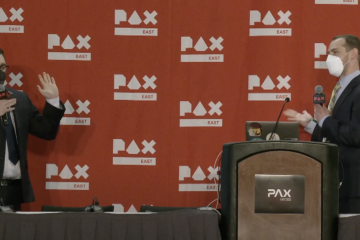
Stop by this weekend and join Aaron Suduiko and Dan Hughes as they dive into select horror games and the oeuvre of Hidetaka Miyazaki!
“Press X to Scream”: Horror Storytelling in Video Games
Where: Hydra Theatre
When: Friday, 8/30, from 10:00 P.M. to 11:00 P.M.
What’s scary? From the interstellar identity crisis of Prey, to the dystopian terror of BioShock, to the existential alienation of SOMA, there seems no end to the ways a game can try to scare you. In this panel, the game analysts of With a Terrible Fate will consider what works and what doesn’t in horror games. What can games learn from the rhetoric of fear, the mythology of terror, and philosophical skepticism about reality? Show up and find out!
The Oeuvre of Hidetaka Miyazaki
Where: Sasquatch Theatre
When: Sunday, 9/1, from 5:00 P.M. to 6:00 P.M.
Hemingway, Shakespeare, Hitchcock: the potential of a storytelling medium is measured by the medium’s most influential storytellers, who elevate authorship to auteurship. Hidetaka Miyazaki is living proof that video games are as compelling a storytelling medium as novels, plays, and films. In this panel, the video game analysts of With a Terrible Fate will explore not only the distinctive style and impact of the mind behind games like Dark Souls: we’ll also consider how Miyazaki’s craft has evolved over time, and how the story of his own artistic development can inform our understanding of games like Bloodborne, Sekiro, and Elden Ring. How is one man’s storytelling defining death, discovery, and the art of the story? Join us and find out!
It’s an honor to be returning to PAX West for the third time to dig into some of the gaming topics nearest and dearest to our hearts. We’ve spent the better part of this summer dying repeatedly in Miyazaki’s collective works and getting spooked in preparation for these panels, and we can’t wait to talk gaming analysis with you—it’s one of our very favorite parts of what we do.
Looking to get psyched for our panels ahead-of-time? Check out these articles that dig into the themes of horror, Dark Souls, and Bloodborne.
Articles on horror storytelling in video games:
- From PAX Aus: Horror in Majora’s Mask
- From PAX Aus: The Psychology and Neuroscience of Jump Scares
- Mythology, Horror, and the Unknown: Horror Traditions in Video Games
- From PAX Aus 2016: Guilt & Inequity in Silent Hill 2
- Why SOMA is More Fact Than Fiction
- Does Silent Hill Belong in the Video Game Canon?
- Does Silent Hill 2 Belong in the Video Game Canon?
- Does Silent Hill 3 Belong in the Video Game Canon?
- Does Silent Hill 4 Belong in the Video Game Canon?
- Does Five Nights at Freddy’s Belong in the Video Game Canon?
- Does Dead Rising Belong in the Video Game Canon?
- The Horror of Setting in EarthBound
- Not Just Monika: Sadistic Horror in Doki Doki Literature Club
- LAN Party: What’s Your Scariest Gaming Memory?
Articles on the storytelling of Dark Souls:
- “YOU DIED”: Despair and Transcendence in Dark Souls
- The Philosophical Justification for FromSoftware’s DLC
Articles on the storytelling of bloodborne:
- Bloodborne, Lovecraft, and the Dangerous Idea
- Why It’s a Good Thing That Dark Souls Isn’t Coming Back
See you soon, PAX West—we can’t wait for you to meet With a Terrible Fate.

0 Comments