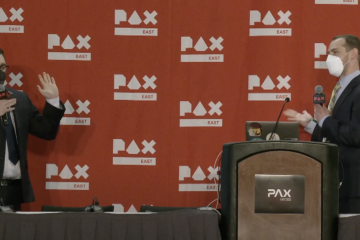
Will you be attending PAX East 2022 this coming week? Physically or virtually, the With a Terrible Fate team is honored to invite you to join us for a panel celebrating the storytelling power of video games: “The Oeuvre of Hidetaka Miyazaki, Part 2: Rise, Tarnished!”
This presentation will be held on Thursday, April 21st, 7:00-8:00 P.M. (E.T.) in the Dragonfly Theatre, and streamed simultaneously on PAX Twitch channels. Whether you’ve seen our previous panels and are a FromSoftware veteran or are just hearing about us for the first time and are discovering Hidetaka Miyazaki through Elden Ring, we’d love to see you there!

PAX has cultivated some of the best gaming communities around the world, and it’s been a distinct privilege for With a Terrible Fate to present panels analyzing a wide range of topics in video-game storytelling over the last six years. The specific panel you’ll see next week is particularly special to us because it’s an all-new topic that follows in the footsteps of several of our older panels that analyzed the work and impact of modern gaming auteur Hidetaka Miyazaki.
Works of Miyazaki’s such as Dark Souls, Bloodborne, and Sekiro: Shadows Die Twice have impacted us culturally, artistically, and personally—in fact, Dark Souls was one of the very first games analyzed at With a Terrible Fate when the site evolved from a Majora’s Mask analysis into a publication dedicated to better understanding and appreciating video-game storytelling. Three years ago at PAX West, we analyzed Miyazaki’s evolving perspective as a storyteller over the years; two years ago at PAX East, we analyzed how other video-game storytellers have responded to that perspective with works of their own; now, we’re turning our attention to Elden Ring to see what we can learn about Miyazaki and one of the most insanely popular games in recent times by putting it in conversation with his earlier works.
Here’s the full panel description so you can know what to expect:
Three years ago, when Sekiro: Shadows Die Twice was a recent release and Elden Ring was a promise without a release date, the video game analysts of With a Terrible Fate descended on PAX West for a panel exploring what the storytelling of Hidetaka Miyazaki’s body of work could teach us about his authorial perspective and about the art form of video games. Now, against all odds, we are living in a world in which Elden Ring was actually released—and With a Terrible Fate is back to explore how this landmark work has reinforced, challenged, and dialogued with the earlier works of Miyazaki. Is it fair to call Elden Ring ‘Dark Souls 4’? When we get over the pain and frustration of countless failures, what is Miyazaki really trying to SAY with this game? What was gained and lost by one great creator giving birth to a game in close collaboration with another, George R. R. Martin? How many deaths does it take to get to the narrative center of Elden Ring? Show up and find out!
Looking to pregame the panel with more analysis of Miyazaki’s works? We have plenty for you to choose from listed below, including two brand-new works as a panel preview: “The Gwyn Moment” and “How Elden Ring Turns Its Player into an Outer God”! We hope that you enjoy them, and if you have any questions or discussion points about them, we’ll be on-hand in Boston next Thursday for plenty of good gaming and conversation.
Here’s a full roundup of our analyses specifically of Miyazaki’s works:
Articles on the storytelling of Dark Souls:
- “YOU DIED”: Despair and Transcendence in Dark Souls
- The Philosophical Justification for FromSoftware’s DLC
- Why It’s a Good Thing That Dark Souls Isn’t Coming Back
- The Gwyn Moment
Articles on the storytelling of Bloodborne:
- Bloodborne, Lovecraft, and the Dangerous Idea
- The Philosophical Justification for FromSoftware’s DLC
Articles on the storytelling of Elden Ring:
We can’t wait to see you soon, PAX East! Until then, game on.

0 Comments