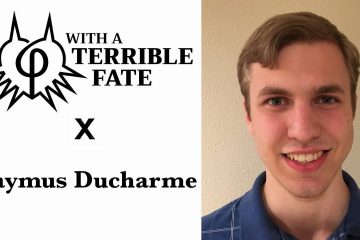
The following is an episode of The Drawing Board, a podcast and video series by With a Terrible Fate that highlights the unstructured conversations about video games from which our analytical content is derived.


Today, we’re delighted to introduce a new video interview series, Meet the Game Analysts, designed to give readers of With a Terrible Fate a richer understanding of the people behind the video-game-story analyses you’ll find on this website.

To kick off the series, Dan and Aaron sat down with Lauren Spohn, the latest addition to With a Terrible Fate’s team of video game analysts. Lauren made her video game analysis debut with “The Outset Island Effect,” an article using The Legend of Zelda: The Wind Waker and Marcel Proust’s In Search of Lost Time to explore how and why video game music often stays with us throughout our lives in ways that other kinds of music do not.

We spoke with Lauren about a wide range of topics, including:

  • How she got started with video games and video game analysis
  • What The Wind Waker means to her
  • A close study of “The Outset Island Effect”
  • The past, present, and future of co-op gaming
  • Whether and how she sees video games dovetailing with her interests in aviation and her intellectual history program at Oxford
  • How to approach video game analysis in a way that improves our passions for the medium, rather than detracting from those passions
  • Which video games and storytelling topics she’s most eager to analyze next

Check out the full interview below—and look forward to more insights from Lauren in the future!


Avatar photo

Aaron Suduiko

Aaron Suduiko is the Founder and Chief Video Game Analyst of With a Terrible Fate. In his capacity as a philosopher of video-game storytelling, he specializes in the relationship between player and avatar, and the myriad ways in which that relationship centrally influences the stories of video games. The heart of Suduiko's philosophy of video-game fiction is his theory of "the fictional player": according to this view, the player's role in a video game is not that of identification with the game's avatar; instead, the player plays a separate, more metaphysically foundational fictional role that makes possible events within a video game's story actual, similar to Leibniz's conception of god. Suduiko's application of this view in his analyses on With a Terrible Fate have led to novel interpretations of games such as Bloodborne, Dark Souls, Dishonored, NieR, Returnal, Xenoblade Chronicles, Bandai Namco's "Tales of" series, BioShock Infinite, Code Vein, Final Fantasy VII Remake, Ni No Kuni, and Silent Hill. The foundations of the fictional player theory may be found in the Journal of the Philosophy of Games: https://journals.uio.no/JPG/article/view/4799/5504 Suduiko graduated Harvard College in 2017 with high honors in his major, philosophy. Part of his degree included three independent studies on the storytelling of video games, advised by philosophy professors. In his senior year, he wrote an honors thesis on the ontology of video games as a storytelling object, earning high honors for the written work and highest honors for his oral defense of it. Suduiko has shared his work on the philosophy of video-game storytelling at a variety of venues, including: Harvard’s philosophy department; PAX West, PAX East, PAX South, and PAX Aus; Harvard’s annual ARTS FIRST festival; the British Society of Aesthetics’ postgraduate conference; and SUNY Oneonta’s undergraduate philosophy conference. An article adapted from a chapter of his thesis on the ontology of video-game storytelling was published in the peer-reviewed Journal of the Philosophy of Games. His work on the aesthetics of quantum mechanics in BioShock Infinite was published in Cornell’s undergraduate philosophy journal, Logos. He’s advised Harvard librarians about the literary value of video games and the need to make them available as library resources. Suduiko started analyzing video games in his senior year of high school, when he compared and contrasted the role-playing dynamics of video games and stage plays. After he started his degree in philosophy in 2014 and heard about the 3D remake of Majora’s Mask, he created With a Terrible Fate as a personal blog analyzing the philosophical and artistic value of Majora’s Mask. Since then, he’s grown With a Terrible Fate into a publication of video game analysts striving to understand the stories of video games in new, rigorous, illuminating ways. Suduiko is currently pursuing a PhD in philosophy at the University of Southern California. Beyond the direct analysis of video-game stories, his main research interests center on how the structure and dynamics of video-game stories can serve as novel models for illuminating real-world issues of practical reasoning, social context, and personal identity.

1 Comment

Scott Sheppard · January 8, 2021 at 2:23 am

Welcome aboard Lauren! Thanks for being a light of shining nerdiness in a world that lacks enchantment. Your enthusiasm and willingness to share is infectious. I look forward to your future articles!

And I loved the video format for the interview, y’all. I agree that it’s easy to lose the face behind the text-only analysis. This helped me understand her Wind Waker article better. Especially seeing it through the lens of Lauren’s academic interests really made the article take on more meaning for me.

I’m excited to read your thesis when it’s done!

And, as you say, happy new year! Go forth in games.

Leave a Reply

Avatar placeholder

Your email address will not be published. Required fields are marked *