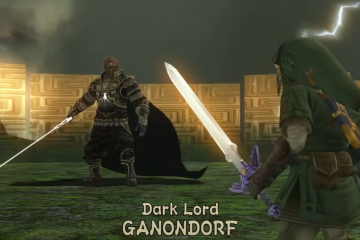
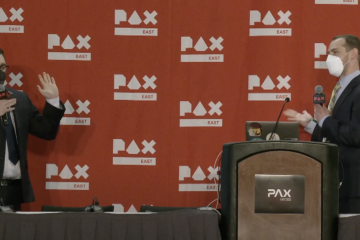
This past April, With a Terrible Fate was honored to give three talks at PAX East in Boston. One of those talks was about our ongoing series, Now Loading… The Video Game Canon! Now you can watch full video footage of the talk online.

The talk—entitled Which Games Belong in the Video Game Canon?—proceeded in two parts:

  1. We talked about the nature of canons, their pros and cons, and why we’re developing one for video-game storytelling.
  2. The audience took a vote on a game to discuss; they chose Paper Mario: The Thousand-Year Door, and they chatted with our panel about whether or not it belongs in the video game canon.

Here’s the full description of what to expect:

Literature, philosophy, religion: every discipline has a canon, a set of texts you need to read to understand and appreciate what is going on. What about the Video Game Canon—the video games you just HAVE to play in order to understand and appreciate how video games tell stories? In this panel, we talk with a video game analyst at With a Terrible Fate who is building this very canon. Come decide which video games should be remembered forever, and which should never have been made at all.

Check out footage of our presentation on what a canon is, and why video-game storytelling needs one, here:

And check out the audience/panel discussion on whether Paper Mario: The Thousand-Year Door belongs in the video game canon here:

It was a pleasure discussing the craft of video-game storytelling with you, PAX East! This follows in the footsteps of a similarly great canon discussion we had at PAX South this past January, and we hope that it foretells other canon conversations still to come!

Avatar photo

Aaron Suduiko

Aaron Suduiko is the Founder and Chief Video Game Analyst of With a Terrible Fate. In his capacity as a philosopher of video-game storytelling, he specializes in the relationship between player and avatar, and the myriad ways in which that relationship centrally influences the stories of video games. The heart of Suduiko's philosophy of video-game fiction is his theory of "the fictional player": according to this view, the player's role in a video game is not that of identification with the game's avatar; instead, the player plays a separate, more metaphysically foundational fictional role that makes possible events within a video game's story actual, similar to Leibniz's conception of god. Suduiko's application of this view in his analyses on With a Terrible Fate have led to novel interpretations of games such as Bloodborne, Dark Souls, Dishonored, NieR, Returnal, Xenoblade Chronicles, Bandai Namco's "Tales of" series, BioShock Infinite, Code Vein, Final Fantasy VII Remake, Ni No Kuni, and Silent Hill. The foundations of the fictional player theory may be found in the Journal of the Philosophy of Games: https://journals.uio.no/JPG/article/view/4799/5504 Suduiko graduated Harvard College in 2017 with high honors in his major, philosophy. Part of his degree included three independent studies on the storytelling of video games, advised by philosophy professors. In his senior year, he wrote an honors thesis on the ontology of video games as a storytelling object, earning high honors for the written work and highest honors for his oral defense of it. Suduiko has shared his work on the philosophy of video-game storytelling at a variety of venues, including: Harvard’s philosophy department; PAX West, PAX East, PAX South, and PAX Aus; Harvard’s annual ARTS FIRST festival; the British Society of Aesthetics’ postgraduate conference; and SUNY Oneonta’s undergraduate philosophy conference. An article adapted from a chapter of his thesis on the ontology of video-game storytelling was published in the peer-reviewed Journal of the Philosophy of Games. His work on the aesthetics of quantum mechanics in BioShock Infinite was published in Cornell’s undergraduate philosophy journal, Logos. He’s advised Harvard librarians about the literary value of video games and the need to make them available as library resources. Suduiko started analyzing video games in his senior year of high school, when he compared and contrasted the role-playing dynamics of video games and stage plays. After he started his degree in philosophy in 2014 and heard about the 3D remake of Majora’s Mask, he created With a Terrible Fate as a personal blog analyzing the philosophical and artistic value of Majora’s Mask. Since then, he’s grown With a Terrible Fate into a publication of video game analysts striving to understand the stories of video games in new, rigorous, illuminating ways. Suduiko is currently pursuing a PhD in philosophy at the University of Southern California. Beyond the direct analysis of video-game stories, his main research interests center on how the structure and dynamics of video-game stories can serve as novel models for illuminating real-world issues of practical reasoning, social context, and personal identity.

0 Comments

Leave a Reply

Avatar placeholder

Your email address will not be published. Required fields are marked *