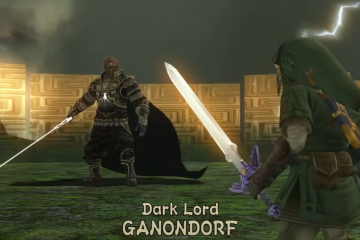
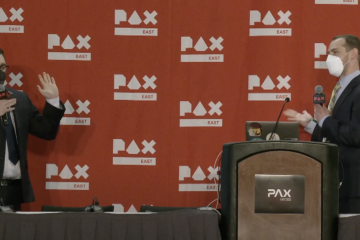
Back in April, With a Terrible Fate had the pleasure of giving three presentations for the peerless people of PAX East. One of those presentations was all about the ways in which video games like Dark Souls, The Legend of Zelda, and Okami are innovating new ways of telling stories episodically—and we have full video footage of it to share with you.

Here’s the description of what you can expect, straight from the PAX East program:

How did Breath of the Wild teach us that the Zelda timeline isn’t as important as we thought? How did Dark Souls II’s DLC convince us that Dark Souls II was incomplete? Video games are developing rich new tools to tell stories across multiple games, add-ons, and episodic content. Join the game analysts of With a Terrible Fate as we dissect our favorite and least favorite series to understand these tools, and to speculate about the next generation of game stories!

Watch the full talk right here:

Thanks for having us, PAX East! We hope to see you again next year.

Like what you saw? Check out all of our other convention presentations here.

Categories: Presentations

Avatar photo

Aaron Suduiko

Aaron Suduiko is the Founder and Chief Video Game Analyst of With a Terrible Fate. In his capacity as a philosopher of video-game storytelling, he specializes in the relationship between player and avatar, and the myriad ways in which that relationship centrally influences the stories of video games. The heart of Suduiko's philosophy of video-game fiction is his theory of "the fictional player": according to this view, the player's role in a video game is not that of identification with the game's avatar; instead, the player plays a separate, more metaphysically foundational fictional role that makes possible events within a video game's story actual, similar to Leibniz's conception of god. Suduiko's application of this view in his analyses on With a Terrible Fate have led to novel interpretations of games such as Bloodborne, Dark Souls, Dishonored, NieR, Returnal, Xenoblade Chronicles, Bandai Namco's "Tales of" series, BioShock Infinite, Code Vein, Final Fantasy VII Remake, Ni No Kuni, and Silent Hill. The foundations of the fictional player theory may be found in the Journal of the Philosophy of Games: https://journals.uio.no/JPG/article/view/4799/5504 Suduiko graduated Harvard College in 2017 with high honors in his major, philosophy. Part of his degree included three independent studies on the storytelling of video games, advised by philosophy professors. In his senior year, he wrote an honors thesis on the ontology of video games as a storytelling object, earning high honors for the written work and highest honors for his oral defense of it. Suduiko has shared his work on the philosophy of video-game storytelling at a variety of venues, including: Harvard’s philosophy department; PAX West, PAX East, PAX South, and PAX Aus; Harvard’s annual ARTS FIRST festival; the British Society of Aesthetics’ postgraduate conference; and SUNY Oneonta’s undergraduate philosophy conference. An article adapted from a chapter of his thesis on the ontology of video-game storytelling was published in the peer-reviewed Journal of the Philosophy of Games. His work on the aesthetics of quantum mechanics in BioShock Infinite was published in Cornell’s undergraduate philosophy journal, Logos. He’s advised Harvard librarians about the literary value of video games and the need to make them available as library resources. Suduiko started analyzing video games in his senior year of high school, when he compared and contrasted the role-playing dynamics of video games and stage plays. After he started his degree in philosophy in 2014 and heard about the 3D remake of Majora’s Mask, he created With a Terrible Fate as a personal blog analyzing the philosophical and artistic value of Majora’s Mask. Since then, he’s grown With a Terrible Fate into a publication of video game analysts striving to understand the stories of video games in new, rigorous, illuminating ways. Suduiko is currently pursuing a PhD in philosophy at the University of Southern California. Beyond the direct analysis of video-game stories, his main research interests center on how the structure and dynamics of video-game stories can serve as novel models for illuminating real-world issues of practical reasoning, social context, and personal identity.

0 Comments

Leave a Reply

Avatar placeholder

Your email address will not be published. Required fields are marked *